State of E-Commerce in Canada 2024
State of E-Commerce in Canada 2024
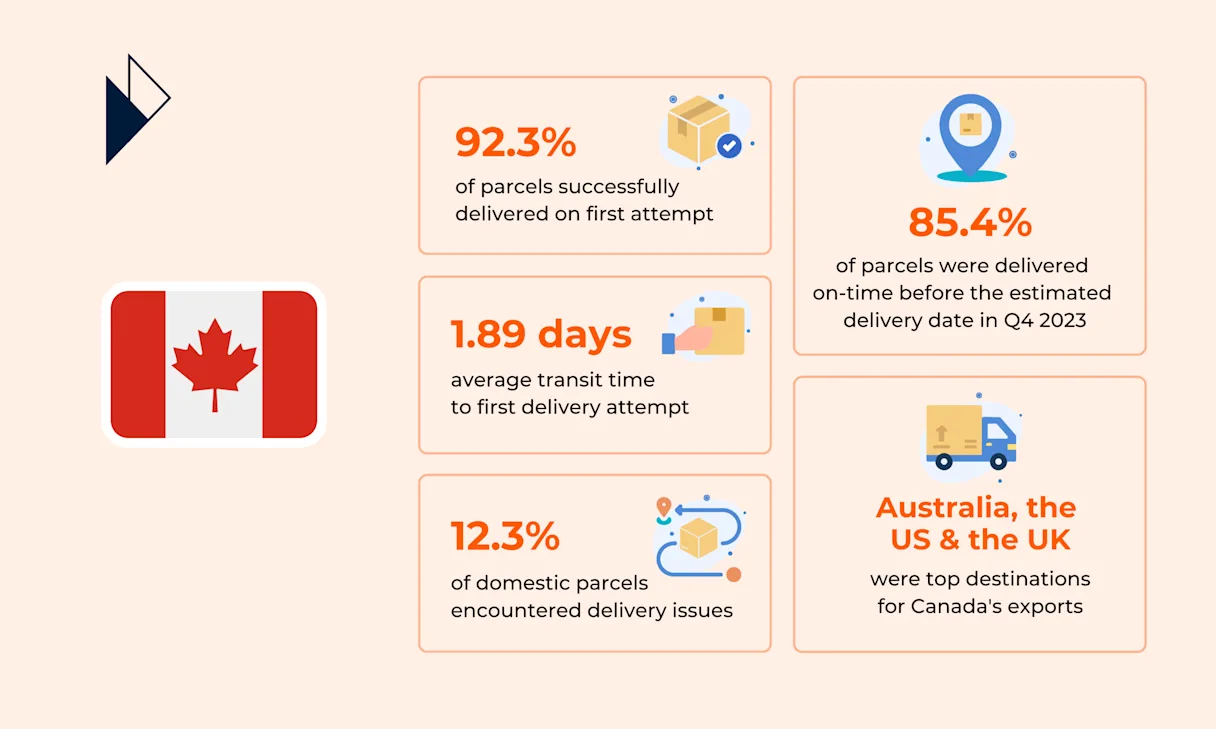
Canada's e-commerce landscape remains robust and dynamic, with 2023 showcasing significant milestones and insights into the country's delivery performance. As online shopping continues to thrive, Canadians rely heavily on efficient logistics and transportation networks to ensure timely delivery of their parcels. Let's delve into the key metrics and trends that defined Canada's e-commerce delivery landscape in 2023.
92.3% of Domestic Parcels in Canada Were Successfully Delivered on First Attempt
Throughout 2023, Canada maintained an exceptional first attempt delivery success rate of 92.3%, a testament to the efficiency and reliability of its logistics infrastructure. This achievement underscores Canada's robust transportation systems, facilitating seamless and dependable parcel deliveries nationwide. Renowned for its effectiveness, Canada's transportation infrastructure consistently earns accolades on the global stage, as reflected in its consistent high rankings on the World Bank's Logistics Performance Index (LPI).
Embracing technological advancements, Canadian logistics companies have invested heavily in cutting-edge solutions to enhance operational efficiency and elevate customer satisfaction. According to a study conducted by PwC Canada, nearly 70% of transportation and logistics executives view technology investments as crucial for improving their services. Notably, the integration of AI-driven route optimization software has revolutionized last-mile delivery services, significantly boosting efficiency and reducing delivery times. Research by Deloitte Canada corroborates these advancements, attributing improved first attempt delivery success rates to AI-driven route optimization technologies.
Canada Observed an Average Parcel Transit Time of 1.89 Days
The average parcel transit time in Canada stood at 1.89 days in 2023, indicating efficient and expedited delivery processes. Behind this notable achievement lies a combination of factors contributing to Canada's swift parcel transit times. Firstly, the country's well-established transportation infrastructure serves as a backbone for efficient logistics operations. Canada's extensive network of highways, railways, and air routes facilitates smooth and expedited movement of goods across vast distances, minimizing transit times and ensuring timely deliveries.
Moreover, the commitment of Canadian logistics firms to customer-centric strategies further accentuates the emphasis on timely deliveries. With a keen focus on meeting and exceeding customer expectations, these companies prioritize swift transit times as a crucial component of their service offerings. By leveraging innovative solutions and continuously refining their logistics operations, they strive to ensure that parcels reach their destinations promptly, enhancing the overall e-commerce experience for consumers.
About 12.3% of Canadian Domestic Parcels Encountered Delivery Issues
Addressing delivery issues is a critical aspect of ensuring a smooth and efficient parcel delivery system, particularly in a country like Canada where the vast geography and diverse population pose unique challenges. Despite Canada's generally high delivery success rates, it's noteworthy that around 12.3% of domestic parcels faced various issues in 2023. These issues encompass a spectrum of problems, including address inaccuracies, failed delivery attempts, and complications arising from customs procedures.
A significant portion of these issues, approximately 7.96% in the fourth quarter of 2023, can be attributed to factors directly related to carriers. This could include issues such as logistical inefficiencies, delays in processing parcels, or errors made by delivery personnel. However, it's crucial to recognize that recipient-related challenges also contribute significantly to the overall problem. This might involve incorrect or incomplete addresses provided by customers, recipients not being available to receive packages during delivery attempts, or difficulties related to customs clearance processes.
In response to these challenges, concerted efforts are being made to enhance various aspects of the delivery process. One key focus is on improving address verification systems to ensure greater accuracy and reduce the occurrence of address-related issues. Additionally, there is a push to enhance communication channels between carriers, senders, and recipients. Clear and timely communication plays a crucial role in resolving delivery issues promptly and efficiently. Providing recipients with tracking information and notifications about their parcels' status can help manage expectations and enable recipients to make necessary arrangements to ensure successful delivery.
Approximately 85.4% of Parcels in Canada Were Delivered On Time
On-time delivery performance refers to the percentage of parcels that are delivered within the specified time frame or according to the promised delivery date. It is a critical metric for assessing the effectiveness and reliability of a logistics system. In Canada, despite facing logistical challenges and seasonal fluctuations, a remarkable on-time delivery ratio of 85.4% was maintained in the fourth quarter of 2023.
The significance of on-time delivery cannot be overstated, as it plays a vital role for both businesses and consumers. For businesses, consistent on-time delivery fosters customer satisfaction, enhances brand reputation, and encourages repeat business. According to a study by MetaPack, 73% of consumers consider delivery speed a critical factor when making online purchase decisions. Thus, a high on-time delivery ratio is a testament to a company's operational efficiency and its ability to meet customer expectations.
Australia, the United Kingdom & the United States Were the Top 3 Destination Countries
In 2023, Canada's export landscape was dominated by Australia, the United States, and the United Kingdom, which emerged as the top three destination countries. These trade routes are not only pivotal for international trade but also serve as catalysts for economic growth, with leading logistics carriers playing a significant role in facilitating the smooth flow of goods between Canada and its global partners.
1) Canada to United States (CA-US)
Given the proximity and strong economic ties between Canada and the United States, the average parcel transit time on this route was relatively short at just 3.63 days. Similarly, the first attempt success rate was an impressive 97.32%, highlighting the seamless logistics coordination between the two countries. Meanwhile, the lower collection point ratio of 4.48% indicates a preference for home deliveries, while the dwell time of 88.44% within 24 hours signifies a highly efficient delivery network in the United States.
2) Canada to United Kingdom (CA-GB)
In contrast, the trade route between Canada and the United Kingdom exhibited an average transit time of 5.01 days, reflecting the intercontinental distance. The first attempt success ratio was high at 95.53%, demonstrating the robust logistics operations involved in this route. The lower collection point ratio of 1.20% suggests a preference for direct deliveries among UK consumers. With a dwell time of 59.88% for collection within 24 hours, the route showcased the UK's effective last-mile delivery ecosystem.
3) Canada to Australia (CA-AU)
Last but not least, the CA-AU trade route exhibited an average parcel transit time of 6.51 days, reflecting the vast geographical distance between the two countries. Despite the challenges posed by distance, the first attempt success ratio remained commendable at 90.42%. Moreover, the collection point ratio of 8.63% indicates a preference for alternative delivery options among Australian consumers. Notably, the dwell time for collection within 24 hours stood at 60.12%, showcasing the efficiency of last-mile delivery in Australia.
Wrapping Up
In summary, Canada showcased a robust dedication to efficient and customer-centric logistics solutions, evident in its high delivery performance levels throughout 2023. However, the presence of delivery issues among a notable percentage of parcels underscores the ongoing need for improvement. As the e-commerce landscape in Canada evolves, it becomes increasingly imperative for companies to prioritize addressing these challenges. By doing so, they can meet the escalating demands of online shoppers and uphold Canada's reputation for excellence in e-commerce logistics.