Success beyond borders: A quick guide to master European e-commerce logistics
Here’s how you can optimize your European e-commerce logistics strategy to boost customer satisfaction and cut costs.
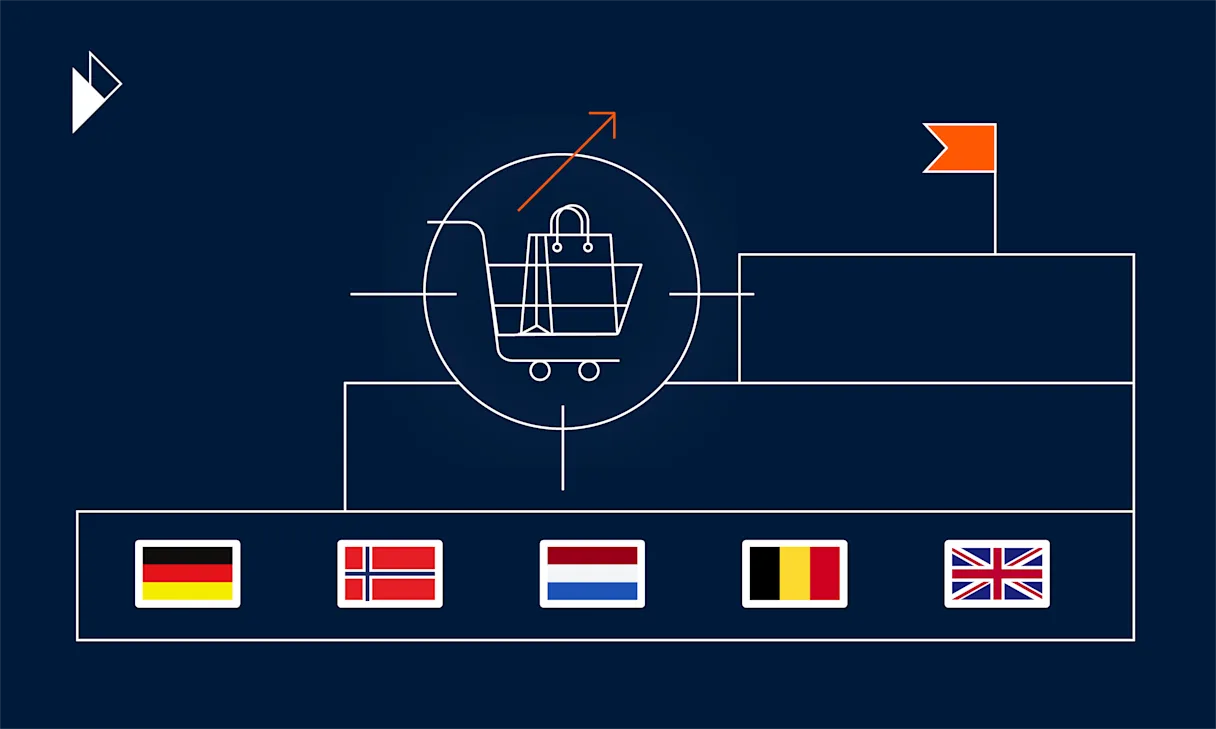
The European e-commerce market has grown significantly over the recent years. Its growth trajectory is also expected to continue in the near future. In a report by eCommerceDB, the European e-commerce market is expected to be worth US$750 billion by 2027. While the European Union (EU) comprises 27 countries, we focused on data from six of these countries leading growth in the EU: Belgium, France, Germany, Norway, the Netherlands, and the UK.
The data collected has been compiled into a report–by Perform.AI’s data and research arm–that showcases the e-commerce and delivery performance in these countries. Through Parcel Monitor’s benchmarking and carrier performance measurement activities, we collected billions of anonymized data points from more than 130 countries annually.
This data is then combined with data from millions of parcels from 1500+ carriers to gain exclusive insights into the European market.
![[image] mid section banner: Download full report EU href="https://resources.parcelperform.com/report/ecommerce-challenges-in-europe"](/_next/image?url=https%3A%2F%2Fimages.ctfassets.net%2F024tjke8lcok%2F6dFtGUKuTYSTiaScRZZgMr%2F5a75040b7a1f60335f51d4b868ed4a88%2FEU_report_image_header.webp%3Fw%3D5760%26fm%3Dwebp%26q%3D75&w=3840&q=75)
European e-commerce landscape: Positive overall, but not without challenges
The expansion of e-commerce in Europe is attributed to increased internet users, mobile devices, and shifting consumer preferences. Despite the pandemic's boost, economic challenges such as inflation and geopolitical tensions have led to decreased online spending, particularly in the UK and Germany. Nevertheless, 57% of European merchants remain optimistic, investing in enhanced customer experiences and delivery options to ensure continued growth.
![[image] EU report - Shopper sensitivity score](/_next/image?url=https%3A%2F%2Fimages.ctfassets.net%2F024tjke8lcok%2F2keQqpTk128m5gIiY1ypvb%2Ffd66f9238d13114e5dba4bccf470350e%2FEU_report_asset_1_-_Shopper_sensitivity_score.webp%3Fw%3D3774%26fm%3Dwebp%26q%3D75&w=3840&q=75)
Rise of PUDO points in Europe
Pickup, and drop-off (PUDO) points are not new to the European market. However, during the pandemic, PUDO points were proven to be a viable fulfillment method. PUDO points in Europe retain post-COVID popularity due to their many advantages:
Convenience: No home delivery wait, especially in urban areas or for those out during the day
Reliability: Less disruption than traditional shipping methods due to accessible locations
Cost-effectiveness: PUDO points are shared by multiple retailers, therefore spreading costs
Sustainability: They reduce carbon emissions and packaging waste due to smaller form factor
Security: Located in well-lit and monitored areas, reducing package security concerns.
According to a report by Last Mile Experts, there are now more than 336,000 PUDO locations available throughout Europe. 43,000 of these PUDO points are automated parcel machines (APMs). Research also shows that there has been a 40% growth in PUDO points throughout the European Union since 2019.
![[image] EU report - Collection points ratio](/_next/image?url=https%3A%2F%2Fimages.ctfassets.net%2F024tjke8lcok%2F01nmhnGOwZSQ75six97wR6%2F1caae977aa550ac8d08a94c586834817%2FEU_report_asset_2_-_Collection_point_ratio.webp%3Fw%3D3672%26fm%3Dwebp%26q%3D75&w=3840&q=75)
However, this growth trend was not uniform across countries. Some countries saw a dip in PUDO point usage after COVID restrictions have been lifted. This could be due to the lack of PUDO points in less dense areas, and a strong consumer preference for much more convenient home deliveries.
Common delivery issues that prevent a seamless delivery experience
![[image] EU report - Percentage of deliveries with issues](/_next/image?url=https%3A%2F%2Fimages.ctfassets.net%2F024tjke8lcok%2F7x3N4KKYLSMkUUBG6hxoAS%2Fa671dcd68ab8b9b12c6a2a9873a99284%2FEU_report_asset_3_-_Deliveries_with_issues.webp%3Fw%3D3843%26fm%3Dwebp%26q%3D75&w=3840&q=75)
Parcel Monitors' data on delivery issues is extensive and covers all of the common causes of delays or non-deliverys. However, they all fall under two broad categories: Issues that stem from the recipient’s end or the carrier’s end.
![[image] EU report - Issues caused on carrier's side](/_next/image?url=https%3A%2F%2Fimages.ctfassets.net%2F024tjke8lcok%2F3p0wDBBpefcw5cytXBmx5q%2Fffbc55a684a39af393ff8087c8813b9e%2FEU_report_asset_4_-_Carrier_side_issues.webp%3Fw%3D4000%26fm%3Dwebp%26q%3D75&w=3840&q=75)
On the recipient side, involuntary returns were one of the most common delivery issues. Oftentimes, this happens because customers are not updated on when their orders will arrive. For carriers, one of the most common problems was unforeseen delivery delays. In countries like Norway and the Netherlands, most of the delivery issues were carrier-related. In Germany, France, and Belgium, delivery issues were customer-related.
Delivery performance: Belgium
![[image] EU report - Delivery performance in Belgium](/_next/image?url=https%3A%2F%2Fimages.ctfassets.net%2F024tjke8lcok%2F6Ex2JAkUMrPEtC6o5nGztd%2Fa32b6092247bdb70774626c439f9967c%2FEU_report_asset_5_-_Belgium_delivery_performance.webp%3Fw%3D4001%26fm%3Dwebp%26q%3D75&w=3840&q=75)
Delivery performance: France
![[image] EU report - Delivery performance in France](/_next/image?url=https%3A%2F%2Fimages.ctfassets.net%2F024tjke8lcok%2F7sgxRNqlVs3I354U243XJN%2F5a5f59ed0f0d967a558c6e54ab113851%2FEU_report_asset_6_-_France_delivery_performance.webp%3Fw%3D4001%26fm%3Dwebp%26q%3D75&w=3840&q=75)
Delivery performance: Germany
![[image] EU report - Delivery performance in germany](/_next/image?url=https%3A%2F%2Fimages.ctfassets.net%2F024tjke8lcok%2F2AieYJhXHBnQBZwudNtvGJ%2Fdbec0c4c4c641c93af875fa5f7e4acd1%2FEU_report_asset_7_-_Germany_delivery_performance.webp%3Fw%3D4001%26fm%3Dwebp%26q%3D75&w=3840&q=75)
Delivery performance: Norway
![[image] Delivery performance in Norway](/_next/image?url=https%3A%2F%2Fimages.ctfassets.net%2F024tjke8lcok%2FYrajVd2Nvo80fZumwusvz%2F5d8ada6780db8633197b7f947794e901%2FEU_report_asset_8_-_Norway_delivery_performance.webp%3Fw%3D4001%26fm%3Dwebp%26q%3D75&w=3840&q=75)
Delivery performance: United Kingdom
![[image] Delivery performance in the United Kingdom](/_next/image?url=https%3A%2F%2Fimages.ctfassets.net%2F024tjke8lcok%2F4jvwBt5Fu1GX4mwksdSg6m%2F81632204763261981ef57b5feb3eb40c%2FEU_report_asset_9_-_UK_delivery_performance.webp%3Fw%3D4001%26fm%3Dwebp%26q%3D75&w=3840&q=75)
Logistics data: Your key to e-commerce success in Europe
The insights we shared can be instrumental in understanding your markets better. But to leverage these insights, you would need to analyze your own logistics data. To do so, you would first need to consolidate data from your end-to-end logistics process and make this data readily accessible from a unified view.
Once you have a unified view of your logistics data, you can start to use it to improve your efficiency and effectiveness. After capturing post-purchase data and making it readily available in a simple platform, you get a holistic view of logistics operations and customer interactions. This this data at your fingertips, you unlock the potential to optimize four experiences in your business.
Checkout experience: Logistics data can be used to provide transparency into the post-purchase process. It arms customers with critical delivery information such as estimated delivery dates (EDD) and the best route options. Giving customers this information helps build trust, and gives customers the confidence to checkout–which translates to a reduction in cart abandonment and higher conversions that drive revenue growth.
Delivery experience: Make real-time tracking information easily accessible to your customers. This can be done via delivery update notifications or even self-service tracking portals on your website. Doing so can help improve customer satisfaction and retention and reduce the likelihood of involuntary returns. It also provides your business with a direct channel to your customers that can be used for brand awareness and upselling.
Returns experience: With data, merchants have the ability to automate a large part of the returns process, such as approvals. It also gives customers the option of performing frictionless self-service returns–starting from choosing refund alternatives, to generating return labels and returns status tracking. This can help to reduce the costs and hassles of returns, improve customer satisfaction, reduce “where is my refund” (WISMR) inquiries, and recapture revenue.
Logistics experience: Logistics data–when consolidated and readily available from a single platform–has the biggest impact on your logistics operations. It enables your logistics teams to optimize complex multi-carrier operations, gauge and benchmark performance, and proactively identify and resolve potential bottlenecks. With full visibility over carrier costs and performance metrics, you’re able to choose the best carrier partners for your e-commerce business.
Each individual experience contributes to the overall e-commerce post-purchase experience. However, when these experiences are combined with a unified data platform, e-commerce enterprises can unlock true business transformation. Instead of making incremental improvements, your business becomes better positioned to create the seamless and convenient post-purchase experience that customers want.
Data is the ideal co-pilot for your e-commerce business
Data empowers businesses to optimize post-purchase logistics by offering real-time insights, proactive issue resolution, and strategic decision-making. By leveraging these advantages, your business can enhance its competitive advantage and drive growth.
Data-driven decisions: Consolidating data offers a clear view of your logistics operations, transforming complex data into actionable business intelligence.
Proactive problem-solving: By standardizing carrier reporting formats, you can automate alerts for any issues, allowing immediate focus on resolutions.
Tracking carrier performance: Monitor the performance of your carriers to identify deviations from service levels and ensure you pay only for delivered services.
Getting your business ready for opportunities
Growth in the European market presents opportunities for businesses. However, consumer preferences are changing. Businesses need to use logistics data to meet the unique demands of consumers. Perform.AI, a logistics data, and delivery experience platform, allows businesses to leverage data to address challenges in the post-purchase process. It enables effective management of end-to-end logistics operations, transforming raw data into actionable insights. This enhances efficiency and customer satisfaction.
The Perform.AI Data and Delivery Experience Platform is created with large e-commerce enterprises in mind and can help streamline operations and improve customer experience. With Perform.AI, your business can:
Get real-time visibility into your supply chain
Identify and resolve potential problems before they impact customers and revenue
Reduce operational costs and improve efficiency
Increase customer satisfaction and loyalty to achieve growth
If you're a business looking to achieve growth in the European market, Perform.AI is the partner for you. Contact us and book a demo today to learn more about how we can help you reach your goals.