The Last-Mile Paradox - Why Cross-Network PUDO Density is the Only Metric That Matters
Single-carrier lockers fail. Aggregating PUDO networks solves the density gap and saves €0.40 per parcel.
The single-carrier locker model is dead. Here is how aggregating networks solves the density deficit to bypass residential surcharges and unlock €0.40 in per-parcel savings.
The modern e-commerce checkout is suffering from a crisis of alignment. While brands invest heavily in optimizing the "Buy" button, the "Delivery" button remains a primary source of friction, churn, and margin erosion. The data is unambiguous: 31% of Americans had packages stolen in the past year, and 10-20% of e-commerce packages fail on the first delivery attempt.
This friction creates a "Last-Mile Paradox." Consumers demand faster, free delivery, yet the method used to fulfill that demand—residential home delivery—is becoming increasingly unreliable due to theft and the return-to-office shift, and increasingly expensive due to carrier surcharges.
For Chief Operating Officers and VPs of Supply Chain, the solution is not to force more volume through the residential channel. The solution is to decouple the delivery location from the carrier network. By implementing a Pick-Up, Drop-Off (PUDO) strategy that aggregates disparate carrier networks into a single, cohesive map, brands can solve the density problem that has historically plagued out-of-home delivery.
This analysis explores why the single-carrier locker strategy has failed, how cross-network aggregation transforms the user experience (UX), and how leveraging a PUDO Locations API can convert your delivery infrastructure from a liability into a margin defense engine generating €0.40 savings per parcel [Note: Perform.AI insight from customer case studies].
Why is Home Delivery Failing the Modern Consumer?
The failure of the home delivery model is driven by three converging structural forces: the density deficit of single-carrier networks, the incompatibility of logistics schedules with modern work life, and the unsustainable economics of the "last 50 feet."
1. The Density Deficit and Single-Carrier Failure
Historically, PUDO adoption has been stifled by a lack of convenience. If a merchant ships exclusively via Carrier A, the customer is limited to Carrier A's locker network. In many urban and suburban environments, the nearest specific carrier point may be kilometers away.
This creates a broken convenience calculation. A customer will not walk 15 minutes to retrieve a package to save the merchant shipping costs. They will choose home delivery, even if they fear theft. However, when networks are aggregated—combining DHL, UPS, FedEx, and independent networks like InPost—the number of available points skyrockets. Access to a network of 700,000+ drop-off points changes the geometry of the last mile, reducing the distance to a pickup point from kilometers to meters. Without this density, PUDO is a theoretical option, not a practical one.
2. The Asynchronous Friction of Return-to-Office
The pandemic-era assumption that "someone is always home" is obsolete. As the workforce returns to physical offices, the synchronization between delivery driver schedules (typically 9 AM to 5 PM) and consumer availability has fractured.
This misalignment results in a high volume of "Failed Delivery Attempts," which are operationally disastrous. A failed attempt incurs tangible costs: the carrier may charge for a second attempt, the merchandise remains in operational limbo, and the customer generates a "Where Is My Order?" (WISMO) inquiry. Perform.AI internal benchmarks suggest WISMO inquiries can account for 30-50% of customer service volume, with each inquiry consuming significant customer service resources. PUDO resolves this by enabling asynchronous handover—the package waits for the customer, not the other way around.
3. The Economic Obsolescence of the Doorstep
Carriers are actively pricing the inefficiency of residential delivery into their rate cards. Stopping a 3-ton truck to deliver a single low-value parcel to a residential address is economically inefficient. Consequently, carriers are introducing "Residential Surcharges" and "Peak Demand Fees" that target these routes.
Conversely, carriers reward density. Delivering 50 parcels to a single locker bank reduces fuel, labor, and vehicle wear. Major carriers like DHL have codified discounts, offering savings of €0.20 to €0.40 per parcel [Note: Perform.AI insight from customer case studies] for consolidated PUDO deliveries. For a high-volume shipper, defaulting to home delivery is effectively a decision to pay a "Residential Tax" on every unit sold.
Strategic Implications: Engineering the PUDO-First Checkout
To escape the Last-Mile Paradox, retailers must move beyond offering PUDO as a passive, secondary option. They must engineer a "Cross-Network" checkout experience that prioritizes convenience and steers consumer behavior toward the most efficient channel. This requires three specific capabilities: Data Normalization, Location Agnosticism, and Strategic Incentivization.
Capability 1: Data Normalization via PUDO API
The technical barrier to cross-network PUDO is the "Carrier Data Mess." Each carrier formats their location data differently—varying fields for opening hours, coordinate systems, and service capabilities. Hard-coding these integrations creates brittle technical debt.
The new industry standard involves leveraging a unified PUDO Locations API. This middleware layer fetches, cleans, and harmonizes data from multiple carriers simultaneously.
The Old Way: The IT team builds individual API connections to DHL, Hermes, and InPost. If a carrier changes their data schema, the checkout map breaks.
The New Way: The system utilizes a single API endpoint to retrieve a standardized JSON response. This response normalizes complex data points such as opening hours, cutoff hours, and location type, ensuring the frontend UI remains consistent regardless of the underlying carrier mix. For technical implementation details, see the developer documentation.
Capability 2: Location Agnosticism and Proximity Search
The most effective PUDO strategies hide the carrier complexity from the consumer. The user does not care who delivers the package; they care where they pick it up.
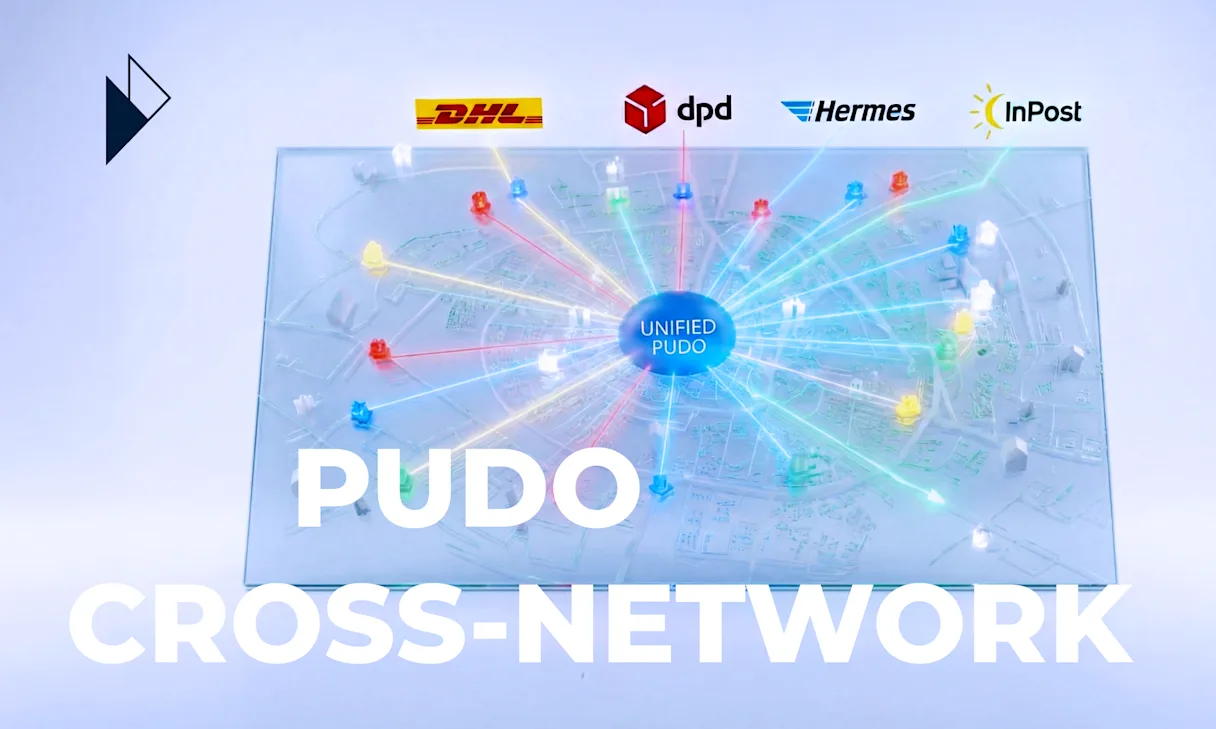
By utilizing proximity search parameters within the API, merchants can display a unified map based on the user's postal code or coordinates. This allows for a "Cross-Network Selection" interface where a DHL locker next to the user's gym appears alongside a DPD shop next to their office.
The Old Way: A dropdown menu asking the user to "Choose a Carrier," followed by a map limited to that carrier's network.
The New Way: An interactive map populated by a query that searches across carrier networks simultaneously. The user selects the most convenient pin on the map, and the Logistics Experience platform automatically routes the shipment to the corresponding carrier on the backend. This "UX Play" prioritizes consumer convenience over carrier loyalty.
Capability 3: Data-Driven Incentivization
Once the technical infrastructure enables cross-network PUDO, financial leaders must incentivize its use. Because PUDO shipments avoid residential surcharges and often attract base rate discounts, they are significantly cheaper to execute—generating savings of €0.40 per parcel [Note: Perform.AI insight from customer case studies] compared to home delivery.
Smart organizations use this margin expansion to fund consumer incentives.
The Old Way: Charging a flat shipping fee regardless of method, masking the true cost of home delivery.
The New Way: Offering "Free Shipping to Lockers" while retaining a fee for home delivery. This price discrimination aligns the consumer's financial interest with the retailer's operational efficiency. Furthermore, utilizing automated shipping cost audits ensures that the carrier invoices accurately reflect these PUDO discounts, preventing overbilling errors which are common when rate cards are complex.
Future Outlook: The State of Out-of-Home Delivery in 2026
Industry analysts predict that by 2026, the "Home Delivery Default" will be viewed as a luxury service tier rather than the standard. The divergence in cost between residential and commercial delivery will widen to over €3.00 per parcel in major metro areas, driven by municipal regulations such as Low Emission Zones (LEZ) and labor cost inflation.
In this environment, the "PUDO-First" strategy will cease to be an option and will become a necessity for margin preservation. Retailers who have built the digital infrastructure to support cross-network aggregation will possess a significant competitive advantage. They will be able to offer free or low-cost shipping options that are profitable, while competitors relying on residential delivery will be forced to pass punitive costs onto the consumer, driving churn.
Furthermore, as AI Commerce Visibility becomes critical, we anticipate that AI shopping agents will begin filtering recommendations based on "delivery convenience" and "sustainability." Brands with a dense, accessible, and aggregated PUDO network will score higher on these Trust Signals, effectively linking logistics infrastructure directly to top-of-funnel customer acquisition.
To explore how your brand can build cross-network PUDO infrastructure and capture these margin gains, book a demo with our team.
Frequently Asked Questions
1. How does aggregating carriers impact the complexity of the checkout integration?
Aggregating carriers actually simplifies the frontend integration if you use a middleware solution. Instead of maintaining multiple API connections, a PUDO Locations API provides a single integration point. You send one request with the user's location, and the API returns a normalized list of valid pickup points from all configured carriers, reducing technical debt and maintenance overhead.
2. Can we filter locations based on specific service capabilities?
Yes. The API allows for granular filtering. You can request locations based on location type (e.g., "Locker" vs. "Retail Outlet") or specific service attributes. This is critical for merchants shipping oversized items who need to filter out small lockers, or for those requiring 24/7 access for customer convenience.
3. What data is required to implement the "Cross-Network" map?
To generate the map, you primarily need the user's country code and postal code or coordinates (latitude/longitude). The API then returns the address, opening hours, and distance in meters for all nearby points, which can be rendered directly onto your map interface.
4. Does PUDO adoption actually reduce customer service costs?
Yes. PUDO deliveries have a near-zero failure rate compared to home deliveries. This eliminates the "Failed Delivery Attempt" notifications and the subsequent "Where Is My Order?" inquiries. Perform.AI customers have seen WISMO reductions of up to 63% by optimizing the post-purchase journey, and shifting volume to secure lockers is a primary driver of this efficiency.
5. How accurately can we estimate delivery dates to PUDO locations?
Extremely accurately. By leveraging AI Decision Intelligence, the platform can predict arrival times based on historical carrier performance to specific locations. This allows you to display an Estimated Delivery Date (EDD) with up to 92% accuracy alongside the location selection, giving customers confidence in when their package will be available for pickup.